If you’ve found a violin, viola, or cello at home with a label reading “Antonius Stradivarius Cremonensis” tucked inside the body, your first reaction was probably somewhere between excitement and disbelief. It’s a common moment for instrument owners, especially those who inherited a violin from a relative or found one in storage.
Before you assume you’ve stumbled onto a multi-million-dollar masterpiece (or panic that it’s worthless), it helps to understand what a Stradivarius label actually is, what it can and can’t tell you, and why so many instruments carry this name without being a genuine Stradivari.
This guide walks you through how to read a Stradivarius label, what its components mean, and why a “Stradivarius copy” can still be a violin worth owning, playing, or even selling.
What are the characteristics of a Stradivarius?
Before diving into the label itself, it’s worth understanding what made Antonio Stradivari’s instruments so distinctive in the first place. A handful of features tend to come up whenever experts discuss genuine Stradivari work:
- A distinctive arching that’s flatter than many of his contemporaries, contributing to a more direct, powerful sound
- Precise, confident f-holes cut with a recognizable elegance and consistency
- A varnish with a unique color and texture, often described as having a warm, reddish-amber tone
- Wood selection, particularly spruce for the top and maple for the back, chosen with exceptional care
- A scroll and purfling work showing remarkable craftsmanship and symmetry
These traits evolved over Stradivari’s long career, and his instruments from his “Golden Period” (roughly 1700-1720) are generally considered his finest. The truly defining characteristics of a Stradivarius go well beyond what’s visible at a glance, which is part of why even experienced luthiers rely on deep study and comparison to make a determination.
What does an authentic Stradivarius label look like?
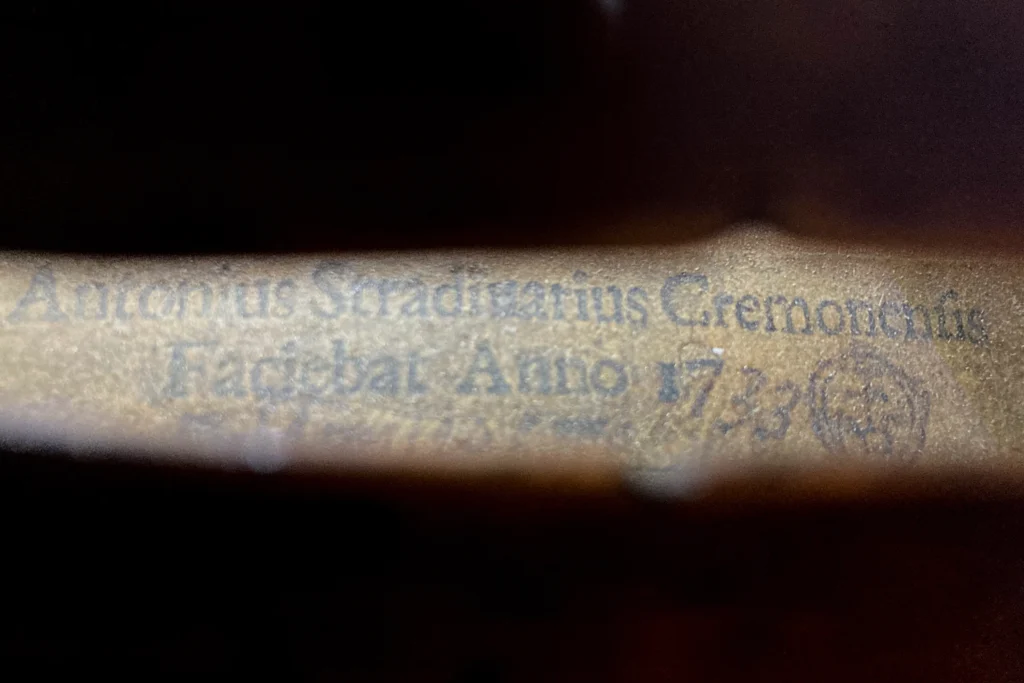
A label alone never confirms authenticity, but learning to read one correctly is a useful first step. Antonio Stradivari’s workshop used a fairly consistent label format throughout his career, typically printed in Latin and pasted inside the instrument, visible through the f-hole.
The text itself
The most recognizable version reads “Antonius Stradivarius Cremonensis Faciebat Anno [year],” which translates roughly to “Antonius Stradivarius of Cremona made this in the year [year].”
The Latinized name and the reference to Cremona, the city where Stradivari worked his entire life, are standard. The year was usually handwritten or stamped onto the printed template, rather than fully printed.
Typography and printing method
Genuine labels from Stradivari’s workshop were printed using period-appropriate typesetting, with letterforms, spacing, and ink that reflect early 18th-century printing techniques.
Modern reproductions, especially mass-produced ones, often use fonts or printing methods that look noticeably different under close inspection, even if they’re not obvious to an untrained eye.
Paper and aging
The paper used for authentic labels shows the kind of aging, discoloration, and fragility consistent with over 300 years of age. It often has a particular texture and tone that’s difficult to replicate convincingly, especially when examined alongside the aging of the surrounding wood.
Placement and condition
In genuine instruments, the label’s position, the way it was pasted, and how it has aged in place tend to be consistent with the instrument’s overall wear pattern.
Mismatches, such as a label that looks far newer or older than the instrument around it, are often one of the first things specialists notice.
It’s worth remembering that Antonio Stradivari is widely regarded for producing some of his best work during the most studied and well-documented period of his career, which is part of why labels from certain years draw extra scrutiny from specialists and collectors alike.
What’s so special about Stradivarius that influenced the market so much?
Stradivari’s reputation grew steadily during his lifetime and exploded in the centuries after his death, as musicians, collectors, and dealers came to regard his instruments as the benchmark for tone, craftsmanship, and value. By the 19th century, owning or playing a “Stradivarius” had become a mark of prestige, and demand for his instruments (real or implied) far outpaced the limited number that actually existed.
How the market responded
This gap between supply and demand created enormous commercial incentive. Violin-making centers across Europe began producing instruments that paid tribute to, or in some cases deliberately imitated, Stradivari’s design and labeling.
Mirecourt, Markneukirchen, and the rise of “Stradivarius” labels
Workshops in towns like Mirecourt, France, and Markneukirchen, Germany, became major centers of violin production from the 18th through early 20th centuries.
Many of these workshops produced solid, well-made instruments at scale, and it became common practice to include a label reading “Stradivarius” or a close variation as a stylistic homage rather than a claim of authenticity.
In many cases, this wasn’t intended as fraud; it reflected a common manufacturing convention of the era, where labeling an instrument after a revered master was a way of indicating the style or model the violin was built to follow, similar to how a furniture maker might describe a piece as being built “in the Chippendale style.”
Over time, some of these labels were used more deceptively, particularly by later sellers rather than the original makers, which is part of why so many instruments in circulation today carry a Stradivarius label without being anywhere close to genuine.
How to tell if it’s a real Stradivarius?
Given everything above, it’s natural to wonder how anyone can tell a real Stradivarius from a tribute, a copy, or a later forgery. The honest answer is that a label alone is never enough; authentication requires a combination of:
- Detailed wood analysis, including grain patterns and aging characteristics
- Close examination of the varnish composition and application
- Comparison of construction details (arching, f-holes, scroll carving) against documented Stradivari instruments
- Provenance research, tracing the instrument’s ownership history when possible
- Dendrochronology in some cases, which examines tree-ring patterns to help date the wood
Why a specialist’s opinion matters
This level of analysis isn’t something that can be done reliably from photos or a quick look inside the f-hole.
Genuine valuation requires the trained eye of a violin specialist or appraiser who has studied documented Stradivari instruments extensively and understands the subtle, often microscopic details that distinguish a genuine instrument from even a very high-quality tribute.
If you’re trying to determine whether an instrument might be worth a formal appraisal, understanding how a violin’s overall condition, origin, and craftsmanship contribute to its value is a useful starting point before pursuing authentication.
It’s also worth emphasizing what we mentioned earlier: if your violin turns out to be a well-made Mirecourt or Markneukirchen instrument rather than a genuine Stradivari, that doesn’t mean it has no value.
Many of these instruments are well-crafted, playable, and sought after by musicians and collectors precisely because of their quality and history, even without the Stradivari name attached.
Have an old violin? Bring it to us.
If you have an older violin, viola, or cello with a Stradivarius label and you’re unsure what you actually have, the safest next step is having it evaluated by people who work with these instruments regularly.
At Amorim Fine Violins, we help instrument owners understand exactly what they own, whether that turns out to be a workshop instrument with genuine playing value or something rarer.
A Stradivarius label is a fascinating piece of history in itself, whether it belongs to a true Stradivari or one of the many instruments built in tribute to his legacy.
Reading the label carefully, understanding its components, and recognizing why so many violins carry this name are all useful first steps. But the only way to know for certain what you have is to have it examined by someone with the experience to tell the difference.
If you’re ready to find out what your instrument is really worth, explore how selling through Amorim Fine Violins works and let our specialists guide you through the process.
Talk to a specialist about this topic

Featured Instrument
 AVAILABLE
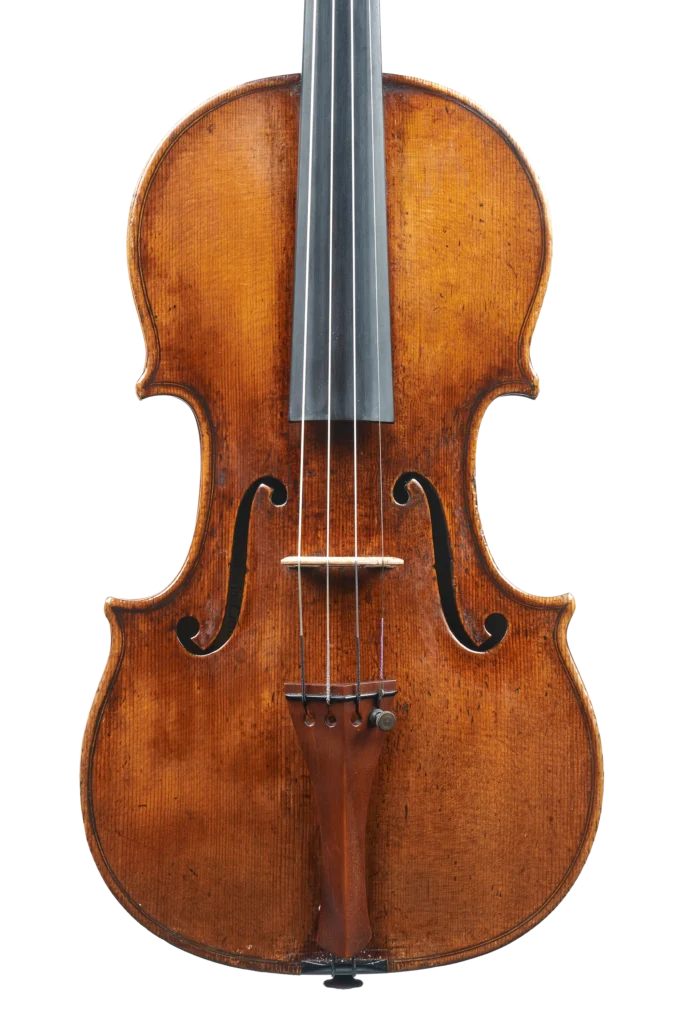
Violin by Antonio Stradivari "Lam; Ex-Scotland University"
Antonio Stradivari — c.1734
View Instrument