The colour of a violin can be amber, golden-yellow, orange, or deep reddish-brown. Its surface may glow with exceptional transparency or reveal the softer texture of centuries of use. Much of this visual character comes from varnishing, one of the most delicate final stages of violin making. Yet a fine varnish does more than make an instrument beautiful: it forms part of the surface that protects the wood and interacts with its vibrations.
For a violin maker, the challenge is to develop a finish that complements the instrument rather than overwhelms it. For a restorer or expert examining an antique violin, the same surface offers evidence of the maker’s methods, the instrument’s age, and the interventions it has undergone. Understanding violin varnish means considering both roles.
What Is Violin Varnish, and What Does It Do?
Violin varnish is a carefully applied coating system, commonly involving the preparation or sealing of the wood followed by transparent or coloured layers. The particular materials and sequence vary between makers and historical traditions. There is no single formula shared by all fine violins, and the visible colour is only one aspect of a successful finish.
The varnish system has several overlapping functions. It moderates the wood’s exposure to moisture and everyday dirt, contributes colour and optical depth, and changes the physical properties of the surface. A coating that is too heavy or inappropriate for the instrument can work against the maker’s acoustic intentions. Equally, insufficient protection or aggressive wear can leave areas of wood more vulnerable.
The Ground and the Coloured Varnish Layers
The ground, or preliminary surface preparation, should be distinguished from the layers that supply much of the final colour and sheen. Depending on the method, the maker may treat or seal the wood before building up the coloured varnish. Because the wood fibres, the ground, and the upper coats interact optically, two violins finished in a similar shade can look surprisingly different under light.
At the Amorim atelier in Cremona, varnishes are prepared from natural materials including oils, essences, pigments, and alcohol. The atelier describes the initial sealer coat as protection for the wood, while the subsequent layers give it colour. Those principles explain its approach, not a universal recipe or a disclosure of its precise formulations.
Protection, Transparency and Texture
A good finish should allow the grain and figure of spruce and maple to remain legible rather than conceal them behind a visually opaque coating. The degree of transparency, the way light moves across the arching, and the texture remaining at the edges all contribute to an instrument’s character.
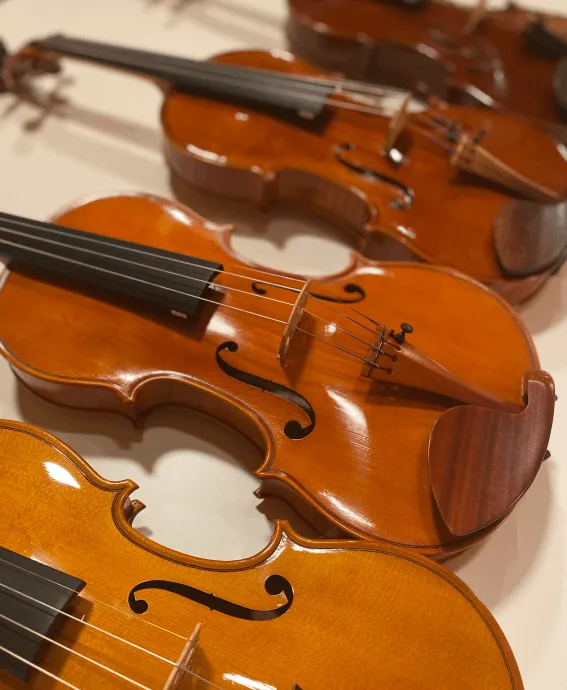
The qualities of the varnish are therefore one element of fine violin craftsmanship, alongside the model, arching, construction, and musical response. No single characteristic, however attractive, establishes the quality of an instrument on its own.
Oil Varnish
Traditional oil varnishes generally combine a drying oil, such as linseed oil, with resinous materials. Some formulations involve heating or cooking components under controlled conditions. The coating develops as the solvent, where present, dissipates and the oil-containing film undergoes chemical curing. Texture, flexibility, hardness, and drying behaviour depend on the actual formulation rather than on the word “oil” alone.
Oil varnish has long been associated with the luminous finishes admired on many historical Italian instruments, but it would be misleading to suggest that every old Italian violin used precisely the same system or that an oil-based finish is automatically superior.
Spirit Varnish
In spirit varnish, resins are dissolved in alcohol, which acts primarily as the solvent and evaporates after application. Makers can build up a finish through successive coats, adjusting the materials and method to achieve a desired colour and surface. Although the absence of oil cooking can simplify some preparations, applying a balanced, refined spirit varnish still demands substantial skill.
Some workshops use combinations or sequences that do not fit neatly into either description. What ultimately matters is the character of the resulting film and how it works with the instrument’s wood and construction.
How Is Varnish Applied to a Violin?
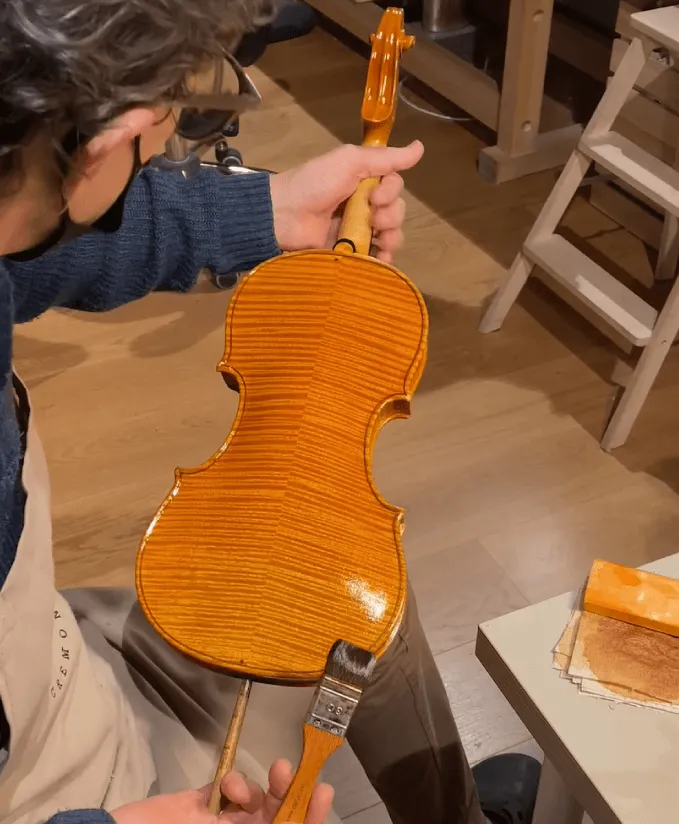
Varnishing begins only after the instrument has been shaped and its wood surface carefully prepared. Traditional finishing may involve scrapers and abrasive plants such as horsetail or other fine finishing techniques. The objective is a clean, coherent surface that does not erase the maker’s tool work or the natural character of the material.
The varnishing process begins with careful preparation of the wood surface. The maker refines the surface using scrapers and other finishing techniques, sometimes allowing controlled exposure to light to develop the wood’s natural colour. A sealing treatment is then applied, followed by successive clear and coloured coats that gradually build the desired transparency, depth, and texture. The number of layers and the specific techniques vary according to the materials, the maker’s working methods, and the intended finish.
Between coats, the maker must judge the state of the surface, the progress of drying or curing, and the visual result. Temperature, light, and workshop conditions all matter. A finish is not judged solely by its appearance on the day the final coat is applied: its behaviour as it matures and the instrument is played also deserves attention.
That combination of historical observation and contemporary making is central to the work behind Luiz Amorim's instruments. The atelier studies historical models closely, while making its own decisions about materials and execution.
Does Violin Varnish Affect the Sound?
Yes, varnish can affect a violin’s vibrational behaviour, but the relationship is more subtle than the claim that one particular recipe produces a better sound. A coating adds material to a thin wooden structure and can alter stiffness, damping, and the way the wood exchanges moisture with the environment. How much those changes matter depends on the properties and thickness of the coating, the underlying wood, and the instrument as a whole.
Research on varnish and wood vibration has examined how successive layers influence moisture protection and vibration in violin wood. Other studies have explored how the mechanical properties of varnishes change with vibration frequency. These studies support a measurable physical effect; they do not establish a universally best varnish or predict the perceived quality of every finished violin.
The Amorim atelier describes an instrument in the white as often sounding particularly open and free. Immediately after varnishing, the same instrument may feel more closed; as the coating continues to dry and the instrument is played, its response may change. This is the workshop’s practical observation, not a promise that playing will inevitably improve the sound or that varnish maturation is the only cause of change.
Varnish should also be considered together with the other parts of the acoustic system. The instrument’s model, plates, bridge, and soundpost are critical to how a violin produces sound. A fine violin emerges from the interaction of those choices, not from a secret coating considered in isolation.
The Mystery of Stradivari’s Varnish
Few surfaces have inspired as much curiosity as the golden and reddish varnishes of Antonio Stradivari. Their depth of colour, translucency, and surviving traces of the maker’s working method continue to fascinate violin makers, conservators, and musicians. It is understandable that the varnish became part of the enduring search for the “secret” of Cremonese instruments.
Yet there is an important difference between admiration for a historical finish and proof that it contained an unknown, sound-producing ingredient. In a study first published in 2009, Jean-Philippe Echard and colleagues analysed varnish samples from five Stradivari instruments using complementary analytical methods. Their findings identified materials consistent with historical oil- and resin-based finishing practices rather than establishing a unique miraculous substance.
The findings are presented in a scientific examination of Stradivari's varnish. They help clarify the materials and layering of the examples examined, while leaving open many questions about individual workshop decisions, construction, and why one instrument sounds different from another.
Stradivari’s visual language cannot be reduced to a formula. Colour depends on the interaction between ground, varnish, wood, ageing, and the history of use. Surviving instruments do not all present an untouched surface, and restorations or protective applications made over centuries may change what we see today.
The varnish is one important part of Stradivari's violin-making history, but it is neither a standalone proof of authorship nor an explanation sufficient to account for the reputation of his instruments.
Reading Historic Varnish: What the Surface Reveals
When a fine historic violin is examined, its varnish becomes evidence. Specialists consider where the original coating remains, where handling has worn through upper layers, and where restorers may have introduced retouching, polishing, or protective coats. The surface can help illuminate both the maker’s individual approach and the instrument’s life after leaving the workshop.
An old violin should not be expected to look untouched. Wear at the points of contact can be entirely consistent with centuries of musical use. The important questions concern how much original material survives, whether interventions are stable and well documented, and whether later work obscures the historical surface. Original varnish cannot simply be recreated once lost.
How UV Fluorescence Helps Examine Varnish
Ultraviolet examination is one of the methods used by the Amorim Lab. Under controlled UV illumination, different varnish layers, accumulated substances, and retouches may produce contrasting fluorescence. That contrast helps a trained examiner map the surface and locate interventions that are difficult to distinguish in ordinary visible light.
The technique has limits. Fluorescence colours do not, by themselves, reveal the precise chemical composition of a varnish or prove a maker’s identity. Interpretation requires comparison with the visible surface, knowledge of restoration practices, and, when justified, complementary analytical methods.
A documented example is the violin attributed to the Fratelli Gagliano workshop, made in Naples around 1800 and examined by the Amorim Lab. Its dossier records extensive preservation of the original varnish across the instrument. UV examination helped distinguish that coating from localized wear and retouching, including a more significant intervention near the treble-side f-hole. The dossier also describes later surface applications in particular areas. These observations concern this specific violin and are not universal fluorescence rules for Neapolitan instruments.
For a wider view of the techniques used to investigate instrument condition, see the Amorim Lab's examination techniques. Such examinations turn visual observations into a documented condition history.
Why Original Varnish Matters in Historic Instruments
Original varnish forms part of an instrument’s historical substance. It can reveal aesthetic decisions characteristic of a maker or period and contribute to how experts distinguish original work from later interventions. Its preservation may also influence an instrument’s desirability and condition assessment, although value always depends on several factors, including attribution, structure, provenance, and the quality of restoration.
In practice, the most useful question is not whether a 200- or 300-year-old violin has any signs of use, but whether its surviving materials and interventions are properly understood. A technically informed assessment respects ordinary wear and avoids confusing a polished appearance with superior preservation.
When the originality or condition of a varnished surface matters to a purchase or historical attribution, expert examination of historic instruments can provide an essential basis for an informed decision.
Talk to a specialist about this topic
Featured Instrument
 AVAILABLE
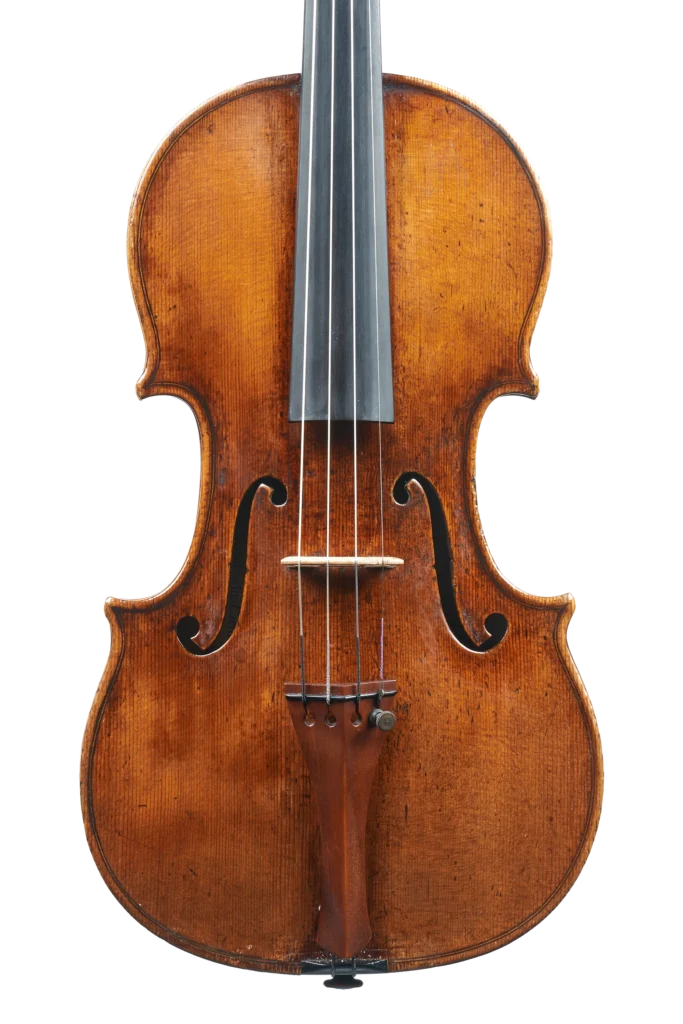
Violin by Antonio Stradivari "Lam; Ex-Scotland University"
Antonio Stradivari — c.1734
View Instrument