Venice holds a singular place in the history of the cello. Some of the most celebrated cellists of the past century like Pablo Casals, Yo-Yo Ma, Gautier Capuçon or Daniel Müller-Schott, have built their careers on instruments built by Venetian cello makers, not Cremonese ones. Casals played a Goffriller for sixty years. Yo-Yo Ma’s primary cello is a Montagnana.
That history sits somewhat apart from the way most cellists first learn to think about Italian instruments. Stradivari, Guarneri, and Amati dominate the popular image of lutherie, and Cremona is usually the first name mentioned when the finest instruments come up. Venetian cello makers rarely get the same billing, despite their instruments being just as present at the highest levels of performance today.
Venice never set out to replicate Cremona. It developed its own school of making, shaped by a different city, a different economy, and a different musical culture, one that produced cellos with a distinct identity and a legacy that continues to define how the instrument is played today.
How Venice Became Relevant in Cello Making
Venice’s great luthiers were almost all migrants. Matteo Goffriller arrived from the Tyrolean town of Brixen. Domenico Montagnana came from Lendinara, near Rovigo. Santo Serafin and Carlo Tononi migrated in from Udine and Bologna. Venice imported talent from across northern Italy and the Alps, and gave that talent somewhere extraordinary to work.
What it offered was opportunity. By the early 1700s, Venice was one of the most musically active cities in Europe. Its four ospedali, charitable institutions that doubled as conservatories, the most famous being the Ospedale della Pietà, where Antonio Vivaldi composed and taught.
Public opera houses, churches, and a wealthy merchant class created sustained, local demand for instruments built to perform, not just admired in a workshop. Venetian luthiers answered directly to working musicians who needed power and projection in real performance spaces.
That shows up in the instruments themselves. Venetian cellos were built broader, with more muscular arching, designed to project a dark, penetrating tone through a crowded hall. The city’s trading position meant materials and ideas moved freely too. Alpine spruce, richly figured maple, and stylistic influence from German and Austrian craftsmanship all flowed into Venetian workshops.
The result was something genuinely its own: a boldness and a warm, reddish varnish that announces a Venetian instrument before a single note is played.
Most Famous Venetian Cello Makers
A handful of names defined this school, most connected to one another through apprenticeship, family, or simple proximity in the same few streets near Calle dei Stagneri.
Domenico Montagnana
If one Venetian name rivals Stradivari’s in a cellist’s imagination, it’s Montagnana’s.
Born in 1686, he arrived in Venice around 1701 and trained either with Matteo Sellas or, as many scholars believe, alongside Matteo Goffriller, before opening his own workshop in 1712 under the sign “Alla Cremona.” Even then, it was a nod to the tradition he was working in dialogue with rather than copying.
Montagnana developed a cello model that broke from convention: shorter than the standard Stradivari “B” form but noticeably wider through the center bouts. That extra width gives his instruments an unusually large vibrating surface and an earthy, commanding sound that many soloists find more immediate to play than a Stradivari.
His instruments today sit in the hands of artists including Yo-Yo Ma, Steven Isserlis, and Mischa Maisky.
Matteo Goffriller
Goffriller is where the Venetian school effectively begins.
Born around 1659 in Brixen, he arrived in Venice in 1685 to apprentice with the luthier Martin Kaiser, married Kaiser’s daughter, and inherited the workshop by 1690. For the next two decades he had little competition, becoming the first Venetian maker to specialize almost exclusively in violins and cellos.
His cellos are known for a deep, dark, almost smoky power, and for the rich red-brown varnish that became the visual signature of the entire school. Many of his instruments went unlabeled for decades, which meant his cellos spent over a century misattributed to Bergonzi, Guarneri, and even Stradivari before scholars sorted out the truth in the 1920s.
Today they’re recognized as some of the finest cellos in existence, played by Gautier Capuçon and Daniel Müller-Schott, and for most of the twentieth century, by Pablo Casals himself.
Just how far that influence reached beyond his own workshop is the subject of how Matteo Goffriller shaped Venetian lutherie beyond Cremona, tracing his impact on the generation of makers who followed him.
Santo Serafin
Serafin moved to Venice from Udine around 1720 and didn’t establish his own workshop until 1733. The gap suggests years spent absorbing techniques in other Venetian shops before stepping out under his own name.
What emerged was widely considered the most refined and elegant work of the entire school. Amati-inspired proportions, exceptional wood selection, and a level of finish that set him apart from the more rough-hewn power of Goffriller or Montagnana.
His cellos are rarer than his violins, since he made comparatively few, which only adds to their desirability among collectors today. He retired from active lutherie in 1744 but kept working in a more limited capacity until his death in 1776.
Carlo Tononi
Tononi brought a different lineage into Venice altogether.
Trained in Bologna under his father Giovanni, he didn’t relocate to Venice until 1717, after his father’s death left him to continue the family workshop alone. Once there, he worked alongside Matteo Sellas and absorbed enough of the surrounding Venetian style, Amati and Stainer-influenced patterns, full arching, refined purfling, that his later instruments are sometimes confused with those of his adopted city’s native makers.
His cellos are rare, since violins and violas made up the bulk of his output. The ones that survive carry the grand, projecting character typical of Venetian instruments from this period.
Francesco Goffriller
Francesco worked alongside his father Matteo in the family workshop before establishing himself independently. For years he was thought to be Matteo’s brother, though archival research later confirmed he was in fact his son.
He left Venice in 1714 to build a career in Udine, carrying his father’s varnish recipe and construction principles with him. His instruments are often discussed as a continuation of the Goffriller voice rather than a wholly separate style.
Susan Babini, principal cellist of the Milwaukee Symphony Orchestra, plays an early-18th-century Francesco Goffriller that has been in her family for three generations.
Who Plays Venetian Cellos Today?
The clearest proof that Venetian cellos belong in the same conversation as Cremonese instruments is simply who chooses to play them.
Pablo Casals could have built his career on a Stradivari. He had the standing and resources to choose almost anything. Instead he picked a 1733 Goffriller and played it for sixty years, fundamentally shifting how the music world perceived Venetian instruments in the process.
That cello is now loaned periodically to winners of the International Pablo Casals Cello Competition, and the broader “Casals” Goffriller lineage continues to circulate among major prizewinners, including the winner of the 2026 Queen Elisabeth Cello Competition.
That pattern has held across generations of the world’s greatest cellists since:
- Gautier Capuçon has performed for over two decades on a 1701 Goffriller nicknamed “L’Ambassadeur,” and has named a Montagnana as his dream instrument
- Yo-Yo Ma‘s primary cello is a 1733 Montagnana
- Daniel Müller-Schott has played Goffrillers for most of his career, describing their sound as having an “aliveness,” almost like boiling oil
- Harriet Krijgh performs on a 1723 Montagnana
- Truls Mørk plays a Montagnana from 1723
- Jacqueline du Pré played a Francesco Goffriller before her famous Davidov Stradivari
- Mstislav Rostropovich kept a 1733 Goffriller alongside his Stradivari throughout his career
This isn’t a niche preference among historically-minded players. It’s a pattern that has held for over a century, across very different musical generations.
How Expensive Is a Venetian Cello Today?
For collectors and investors, the Venetian school occupies a position that’s becoming increasingly attractive. These are instruments of unquestionable historical and musical importance, produced in far smaller numbers than their Cremonese counterparts, in a market that hasn’t been picked over to the same degree.
That scarcity translates directly into value. Authenticated Montagnana cellos have sold privately for well over a million dollars, with examples like the 1733 “Mayes,” now owned by Yo-Yo Ma, regularly cited as benchmark instruments in the field. Serafin cellos have reached auction prices in the hundreds of thousands of pounds. A fine Goffriller now commands prices that reflect exactly how thoroughly that perception has reversed over the past century.
For collectors thinking about long-term value rather than short-term liquidity, Venetian instruments offer something Cremona increasingly can’t: real rarity at a price point that, relative to the very top of the Cremonese market, still has room to grow.
Owning an authentic 18th-century Venetian cello isn’t realistic for most musicians or collectors. That’s precisely why faithful, expertly built copies of these historic models have become a serious category of their own.
As an example, Amorim Fine Violins recently sold a Matteo Goffriller, the ‘Ex-Meneses’. A remarkable example of the craftsmanship of a luthier from Bressanone who was active in Venice in the late 17th and early 18th century.
It’s a way of putting the sound and the legacy of Montagnana’s workshop into a working musician’s hands, without competing for one of the small number of surviving originals.
At Amorim We Cherish Italian Cellos, and More
Our work is rooted in Cremona, but our appreciation for Italian lutherie has never stopped at the city limits. Venice’s contribution to the cello, like its sound, its scarcity, its sheer influence on what cellists around the world still choose to play today and deserves the same attention and expertise we bring to the Cremonese tradition.
Whether you’re drawn to the power of a Goffriller, the breadth of a Montagnana, or a master-crafted copy that brings that same voice into reach, understanding the history behind the instrument is the first step toward choosing the right one.
Our collection of cellos includes antique masterpieces and contemporary instruments built in that same old tradition, for serious collectors and performing musicians alike.
Talk to a specialist about this topic

Featured Instrument
 AVAILABLE
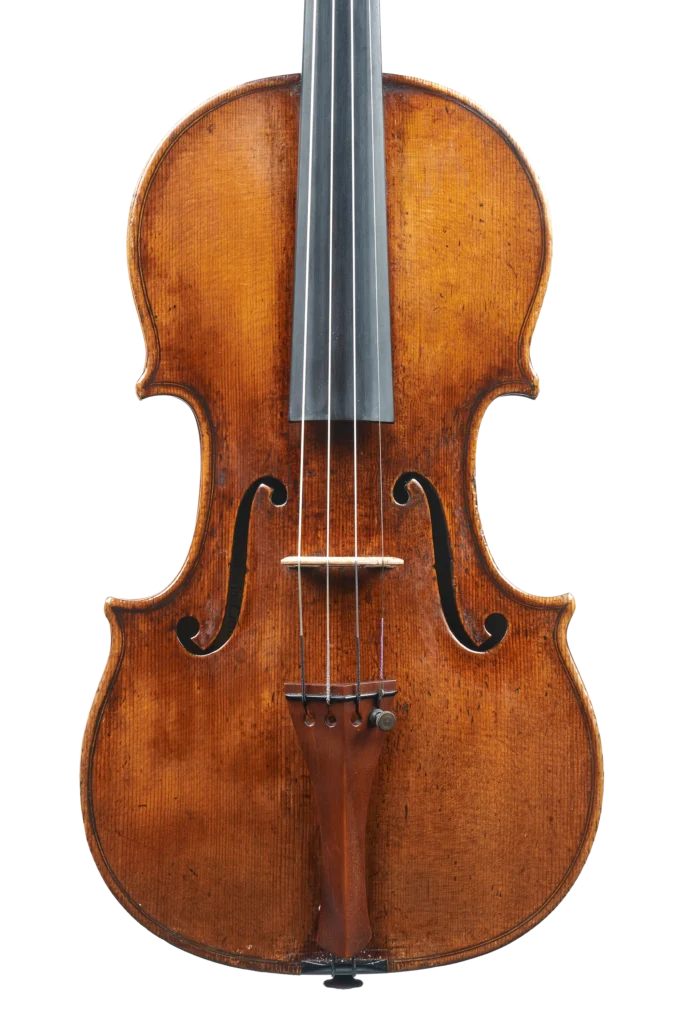
Violin by Antonio Stradivari "Lam; Ex-Scotland University"
Antonio Stradivari — c.1734
View Instrument