The tradition of fine violin making continues to evolve. Today’s artisans combine centuries-old techniques with their own artistic vision, creating instruments that reflect both the legacy of the great masters and the exacting demands of modern musicians. From Cremona, the historic heart of Italian lutherie, to workshops across Europe, exceptional violin making remains a dialogue between craftsmanship, acoustic science, and the unique relationship between an instrument and the musician.
At Amorim Fine Violins, our hands-on experience in making, restoring, and advising on fine string instruments gives us a close perspective on these qualities. The following selection highlights five contemporary makers whose backgrounds, techniques, and distinctive approaches define the current landscape of fine violin making.
What Defines a Great Contemporary Violin Maker?
The finest contemporary makers share a deep understanding of the traditions established by the great Italian masters, yet their work extends far beyond mere reproduction. A violin’s quality rests on a series of interconnected decisions: the selection and seasoning of tonewoods, the precise proportions and arching of the plates, varnishing techniques, and the meticulous final setup.
For professional musicians, tonal character, projection, responsiveness, and ergonomic comfort are paramount. An exceptional instrument must offer the flexibility to express a wide range of musical intentions while retaining its own distinct voice.
Today’s makers interpret historical models through different lenses. Some pursue faithful reproductions of Antonio Stradivari or Giuseppe Guarneri del Gesù, while others develop highly personal approaches to form, texture, and sound. This dynamic balance between reverence for tradition and individual expression defines the highest level of contemporary lutherie.
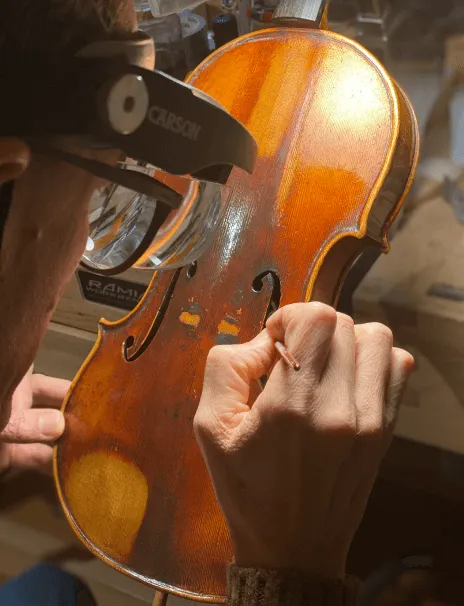
Luiz Amorim
Based in Cremona, Italy, Luiz Amorim merges a fine arts background with a profound interest in the expressive possibilities of string instruments. Born in Curitiba, Brazil, he began his professional journey in the visual arts before dedicating himself entirely to violin making. His experience in drawing, painting, and sculpture deeply informs his craftsmanship, particularly his sensitivity to form, texture, and the unique character of each piece.
His work draws considerable inspiration from the great Italian makers of the past, especially Giuseppe Guarneri del Gesù. For Luiz, Guarneri's genius extends beyond acoustic achievement. He admires the freedom and individuality visible in the master's later instruments, where expressive character often takes precedence over strict aesthetic uniformity.
This philosophy guides Luiz's own approach. While rigorously studying and interpreting historical models, he preserves the creative freedom necessary for each instrument to develop its own identity. As he notes:
“An instrument is like a blank canvas on which I can express my artistic flair as a maker.”
His violins combine a powerful, complex sound with meticulous workmanship and a distinct artistic signature. Careful material selection, precise construction, and exacting final setup remain central to his process, representing a vibrant, contemporary evolution of the Cremonese legacy.
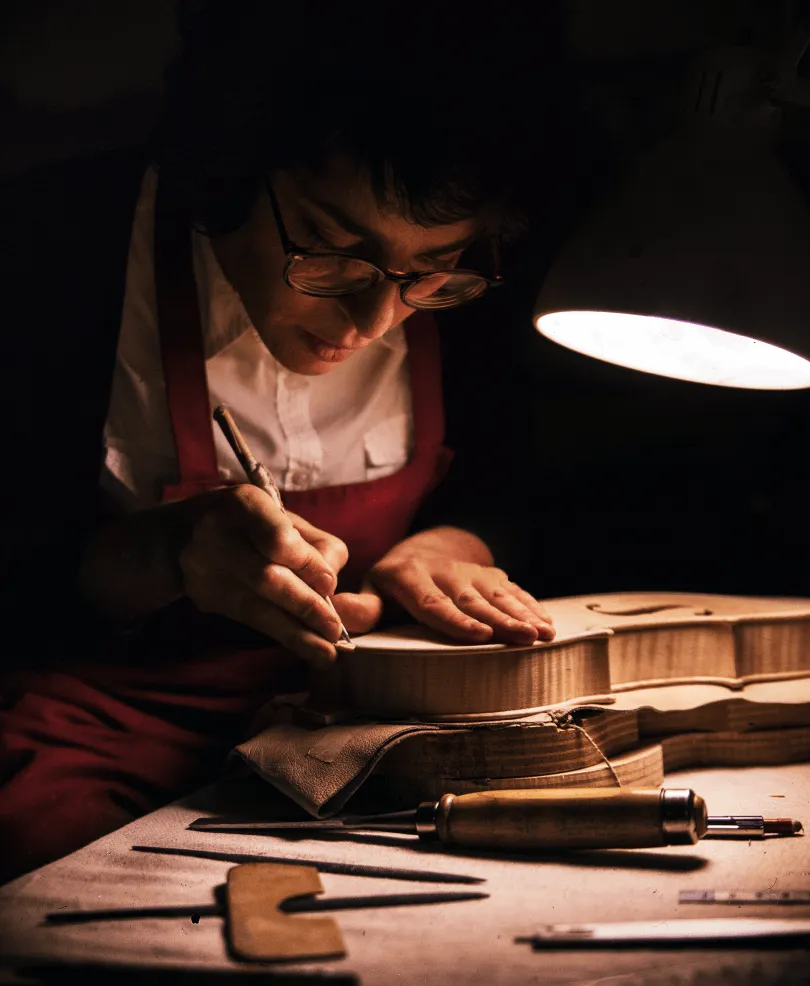
Fiorella Anelli
Working in Cremona, Fiorella Anelli brings a strong foundation in both traditional craftsmanship and the technical disciplines of string instruments. Born in Milan in 1981, she developed an early interest in music through piano studies before discovering violin making. She graduated from the School of Violin Making in Milan in 2004 under Paola Vecchio, later expanding her expertise through specialized training in instrument restoration.
After relocating to Cremona in 2005, Fiorella worked in several prominent workshops, gaining hands-on experience in construction, repair, and sound adjustment. In 2008, she completed advanced studies in Baroque violin making, deepening her understanding of historical construction methods.
Her instruments are rooted in the classical Cremonese tradition, with a sharp focus on tonal balance, structural integrity, and visual refinement. Material selection is paramount in her workshop. She favors carefully seasoned spruce from Val di Fiemme and Balkan maple, pairing these traditional tonewoods with oil varnishes formulated from historical recipes. Her varnishing technique specifically targets the visual depth, texture, and aesthetic warmth characteristic of classical Italian instruments.
Fiorella’s work demonstrates how historical techniques, when paired with modern acoustic knowledge and restoration expertise, yield instruments of exceptional clarity and beauty.
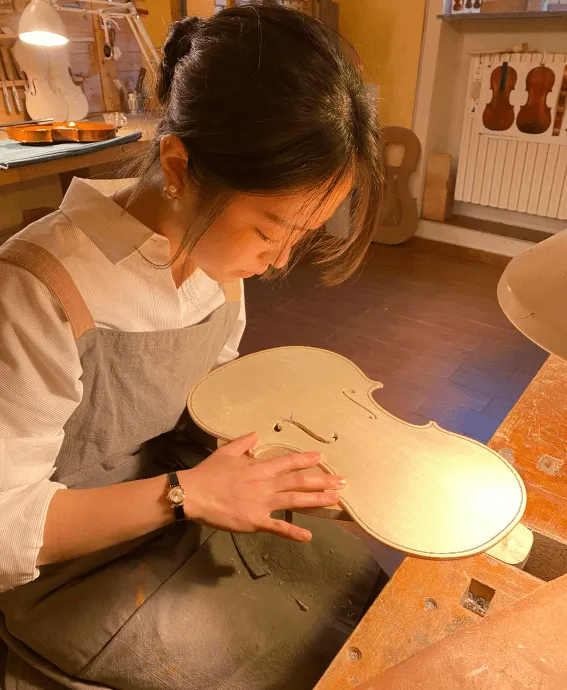
Anna Arietti
Another female violin maker working in Cremona is the rising star, Anna Arietti. She makes violins, violas, and cellos that have their own beauty and sound with high-quality materials. They are also ''one-of-a-kind'' built with comfort to play with a rich, warm low register and a powerful high end.
A distinctive aspect of Anna’s work is her appreciation for the aesthetic qualities of antique instruments. Rather than viewing every irregularity as a flaw, she recognizes the visual character created by subtle asymmetries, tool marks, varnish variations, and the natural wear of time. These details contribute profoundly to an instrument's individuality, especially when interpreted through the traditional practice of antiquing.
Her violins, violas, and cellos reflect this historical character while remaining fully optimized for contemporary performance. Acoustically, she seeks warmth and richness in the lower registers, balanced by strength and clarity in the upper range, without compromising playing comfort. Anna’s work proves that the visual language of historic instruments can inspire modern craftsmanship while fully serving the demands of today’s musicians.
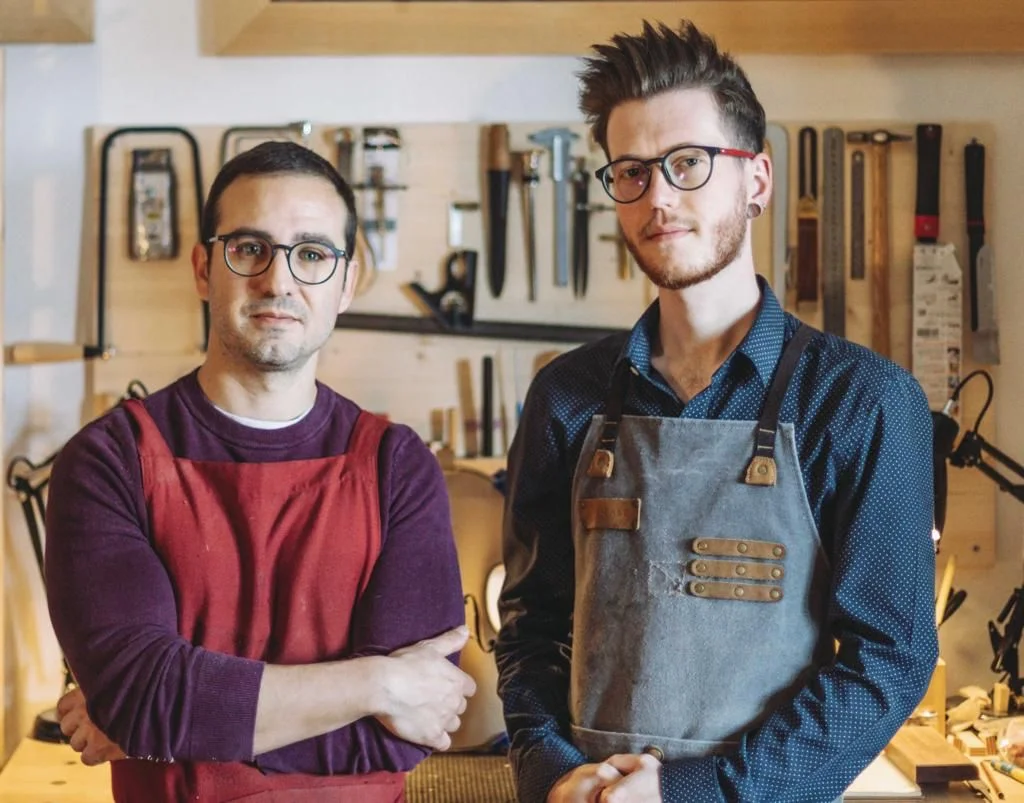
Giovannetti and Schultz
Andrea Giovannetti and Kyle Schultz merge distinct educational backgrounds and experiences into a shared, highly refined approach to violin making. Drawing inspiration from the great Italian masters, their work combines historical research, technical precision, and a deep focus on the acoustic and aesthetic character of classical instruments.
Andrea Giovannetti, born in Florence, began playing the violin at a young age. His fascination with the instrument led him to violin making, which he pursued alongside academic studies in natural sciences and biology. From 2014 onward, he undertook specialized training at the Sandro Pertini Professional Training Institute in Trento and through private instruction with master maker Luca Primon. He later refined his skills in London, working with Andreas Hudelmayer to advance his knowledge of copying and antiquing techniques.
Kyle Schultz, born in South Africa, developed an early interest in both music and the mechanical principles of string instruments. This curiosity drove him to explore instrument construction and repair before undertaking formal training at the Newark School of Violin Making and Repair, where he earned a First-Class Bachelor of Arts degree with Honours.
Together, Giovannetti and Schultz apply their complementary expertise to create instruments inspired by classical Italian models. Their process marries the close study of historical originals with meticulous attention to tonewood selection, construction, varnishing, and acoustic performance. Rather than treating the past as a rigid formula, they explore how traditional techniques can be thoughtfully interpreted through a contemporary lens.
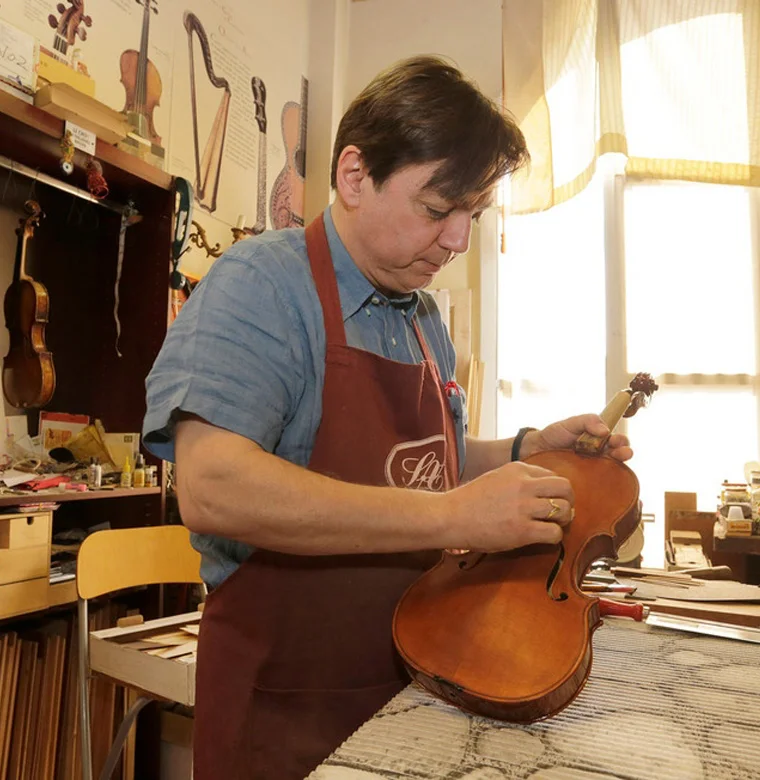
Lorenzo Frignani
Lorenzo Frignani is an established Italian violin maker whose expertise spans instrument construction, restoration, and the scholarly study of historical string instruments. Active in the field since 1986, his career demonstrates a deep commitment to both the practical and historical dimensions of lutherie.
His portfolio includes the construction and restoration of bowed and plucked string instruments, alongside active involvement in educational initiatives and the international violin-making community. Throughout his career, Frignani has earned numerous awards and widespread recognition for his craftsmanship.
His approach is firmly rooted in classical Italian models, particularly the traditions of Emilia-Romagna and Lombardy. Careful material selection and masterful varnishing are central to his philosophy, contributing not only to an instrument's visual presence but also to its structural and acoustic coherence. His extensive background in restoration and historical research provides a unique perspective on contemporary making, bridging traditional methods with the accumulated knowledge gained from studying the masters of the past. Frignani’s work stands as a testament to the seamless continuity between historical craftsmanship and the creation of fine instruments for today’s musicians.
Exploring Contemporary Violin Making Today
The work of these makers highlights the rich diversity of contemporary violin making. While all share a foundational connection to the traditions of the great Italian masters, their individual approaches vary significantly. Some emphasize faithful historical interpretation, while others prioritize personal artistic expression, antiqued aesthetics, or the technical refinement of classical construction.
For musicians, recognizing these nuances is invaluable when selecting an instrument. Ultimately, sound, responsiveness, playing comfort, and the intuitive connection between the player and the instrument matter far more than any generalized ranking.
For collectors and enthusiasts, a maker's background, artistic identity, and dedication to craftsmanship provide deeper context for appreciating a contemporary piece. At Amorim Fine Violins, we believe that understanding the artisans behind these instruments is essential to truly appreciating their value.
To discover more about the history and ongoing tradition of violin making in Cremona, explore the violin makers represented by Amorim Fine Violins, featuring both historic masters and today’s leading contemporary artisans.
Talk to a specialist about this topic

Featured Instrument
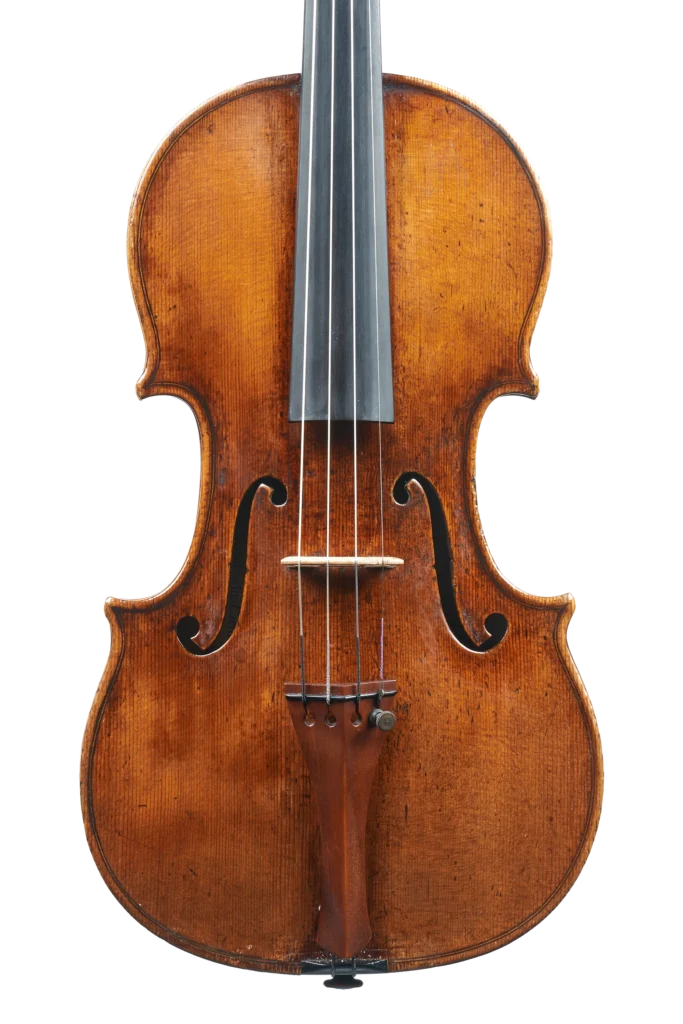 AVAILABLE
Violin by Antonio Stradivari "Lam; Ex-Scotland University"
Antonio Stradivari — c.1734
View Instrument