

The Testore Family: What Is Their History?
Back to BlogIn the late 1600s, northern Italy was already the heart of violin making. Cities like Cremona had achieved legendary status thanks to masters such as Antonio Stradivari and Andrea Amati. Nearby Brescia also held a powerful tradition of instrument makers.
But not far away, another violin-making story was quietly taking shape in Milan.
Unlike Cremona’s polished elegance, Milan’s instruments reflected the energy of a working city. They were built for musicians who needed reliable tools for daily performance, players who demanded strong sound rather than visual perfection.
At the center of this story stood one remarkable family: the Testores. For nearly a century, the Testore dynasty shaped the identity of Milanese violin making, creating instruments that were practical, resilient, and still admired by musicians today.
Milan’s Emerging Violin-Making Tradition
During the 17th century, Milan was one of Europe’s most powerful cities. As part of the Duchy of Milan (first under Spanish rule and later under the Austrian Habsburgs) it remained a major economic and cultural center.
Yet when it came to violin making, Milan initially lived in the shadow of its neighbors. Cremona was home to the great masters like Giuseppe Guarneri del Gesù, Antonio Stradivari, and Carlo Bergonzi, while Brescia had already established a respected tradition of instrument craftsmanship.
Milan’s violin-making school began to develop later, around 1670. When it finally emerged, however, it brought a completely different personality to the craft.
This was a city driven by movement and music. Churches needed instruments for daily services. Theaters hosted constant performances. Musicians required violins that could project sound clearly in large spaces and withstand heavy use.
In this environment, the Milanese violin-making tradition was formed: Defined by bold construction, practical craftsmanship, and instruments built for real-world performance.
Two families stood at the beginning of this school: the Grancinos and the Testores.
Carlo Giuseppe Testore: Founder of the Dynasty
The Testore story begins with Carlo Giuseppe Testore, born around 1660, likely in Novara. By the early 1680s, he had established himself in Milan and began building the foundation of what would become a family dynasty.
A key influence on his work was Giovanni Grancino, one of Milan’s earliest important violin makers. From Grancino, Carlo Giuseppe absorbed elements of the classical style inspired by the Amati family, such as compact body models, elegant outlines, and balanced proportions.
However, Carlo Giuseppe soon developed a personality of his own.
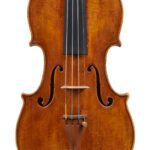
His instruments combined grace with strength. One of his most recognizable features became the distinctive Testore scroll: oval in shape and elongated along the neck, giving the instrument a slightly forward-leaning appearance.
Other characteristics of Carlo Giuseppe’s work include:
- Broad purfling, often incorporating beech wood
- High-quality materials, sometimes with beautifully flamed maple
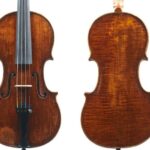
- A strong, compact body model
His cellos in particular gained admiration among musicians. Many were larger than expected and often used local woods such as willow or pear for the back plates, producing powerful and resonant sound.
The Practical Workshop Approach
One of the most fascinating aspects of the Testore workshop was its practicality.
Carlo Giuseppe appears to have used two distinct varnish recipes:
- A darker, reddish varnish that was softer and less transparent
- A lighter golden varnish that dried faster and produced greater clarity
The choice of varnish was not arbitrary. It could depend on several factors, including the quality of the wood, the importance of the commission, and even environmental conditions such as humidity.
Over time, the golden varnish became one of the recognizable visual signatures of the Testore workshop: a detail that continued through later generations.
Carlo Antonio Testore: Expansion of the Workshop
The next generation was led by Carlo Antonio Testore, the eldest son of Carlo Giuseppe. Active roughly from the 1730s through the 1760s, he expanded the workshop and dramatically increased production.
While Carlo Giuseppe established the family identity, Carlo Antonio turned the business into a true dynasty.
The workshop remained in Milan on Contrada Larga (under the sign of the Eagle) one of the central locations of the city’s instrument-making activity.
However, the pace of production changed the character of the instruments.
Carlo Antonio’s violins were often described as bold, direct, and sometimes rough in finish. They drew inspiration from models associated with makers like Antonio Stradivari and Giuseppe Guarneri del Gesù but interpreted them through a distinct Milanese lens.
Certain workshop shortcuts became part of the family’s recognizable style. To modern eyes, these details might appear careless, but they reflected a deliberate response to market demand.
Milan’s musicians needed instruments quickly, and at prices they could afford.
Paolo Antonio Testore: A Maker of Contrasts
Another key figure in the dynasty was Paolo Antonio Testore, the younger son of Carlo Giuseppe.
His work shows dramatic variation. Some instruments appear almost austere in their simplicity, while others display remarkable craftsmanship and acoustic quality.
This variation likely reflects the structure of the workshop itself.
The Testore family produced instruments across multiple tiers, designed for different budgets and professional needs.
High-end instruments might feature carefully carved scrolls, elegant arching, fine varnish and properly inlaid purfling
In the other hand, more affordable instruments might include simpler materials, thinner varnish and, scrolls with partially unfinished fluting
Despite these shortcuts, the acoustic performance often remained the priority. For Paolo Antonio, sound frequently mattered more than aesthetic perfection.
Instruments Built for Musicians
To understand the Testores, it is essential to understand the city around them.
In the early 18th century, Milan was not a quiet court city like Cremona. It was large, active, and politically complex. Music in Milan served a broader public life.
One influential figure in this musical transformation was Giovanni Battista Sammartini, a composer who helped shape the early symphony during the 1730s and 1740s.
Under this influence, musical style shifted from the dense polyphony of the late Baroque toward the clearer melodic expression of the galant style.
The Testore family built instruments for this world.
Their violins were not designed to impress aristocratic collectors. They were built to project sound in busy churches, crowded theaters, and lively public spaces.
Features such as scratched purfling, partially carved scrolls, and deeply cut pegboxes were not mistakes, they were practical decisions that kept instruments affordable and durable.
Durability and Longevity
What makes Testore instruments remarkable today is their survival.
Many have remained in continuous use for nearly three centuries. Unlike Cremonese instruments, which often entered private collections early, Testore violins typically stayed in circulation among working musicians.
They were played night after night, passed from performer to performer, and repaired repeatedly when necessary.
Their worn surfaces and softened edges tell a story of constant musical life.
Rather than sitting in display cases, these instruments fulfilled their original purpose: making music.
Confusion with Guarneri Instruments
Over time, some Testore instruments were altered or misidentified.
Because certain examples share structural similarities with models from Giuseppe Guarneri del Gesù (including strong outlines, expressive f-holes, and powerful tonal character) some instruments were modified to resemble Guarneri violins.
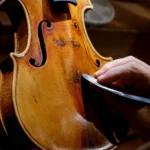
Labels were replaced, scrolls reshaped, and f-holes sometimes adjusted.
However, experts can usually identify a Testore instrument through its varnish and construction style. The varnish of the Milanese school differs significantly from that of Cremona, revealing the instrument’s true origin.
The End of the Testore Era
The Testore dynasty lasted roughly eighty years, from around 1680 to about 1760.
The final phase of the family workshop is associated with Giovanni Testore, the son of Carlo Antonio.
After this period, Milanese violin making did not disappear, it simply evolved. Later makers such as Carlo Ferdinando Landolfi and the Mantegazza family continued the tradition and carried the Milanese school into a new era.
Yet the Testores remain the family that gave Milan its defining early voice.
Why the Testore Family Still Matters
The Testore family did not attempt to compete with Cremona by copying it perfectly. Instead, they created something uniquely Milanese.
Their instruments combined:
- Strong outlines
- Distinctive scroll designs
- Practical construction
- A workshop culture shaped by real musicians
From Carlo Giuseppe’s elegant foundations to Carlo Antonio’s prolific production and Paolo Antonio’s sound-first philosophy, the Testores built instruments meant to live hard musical lives.
And remarkably, many of them are still singing today.
At Amorim Fine Violins, We Do More Than Keep the Tradition Alive
At Amorim Fine Violins, we believe that great instruments are not only objects of history, they are voices meant to continue being heard.
Just like the workshops of Milan once built violins for musicians who played every night, our mission is to connect exceptional instruments with the artists who will bring them to life today.
From carefully restored historical violins to expertly crafted modern instruments, we work to preserve the legacy of great makers while ensuring these instruments continue to sing on concert stages, in studios, and in the hands of dedicated musicians.
Because tradition is not only about preservation.
It is about continuity.
Explore our collection or speak with our experts to discover an instrument that will carry your music forward.