Few figures in classical music have inspired as much fascination as Niccolò Paganini. Celebrated as the Devil’s Violinist, Paganini redefined violin technique, captivated nineteenth century Europe, and left behind one of the most legendary instruments ever created, the 1743 Guarneri del Gesù known as Il Cannone.
More than two centuries later, his name remains synonymous with virtuosity, innovation, and myth. His story is not only about extraordinary talent. It is about how one artist and one instrument reshaped the course of music history.
Why Was Paganini Called the Devil’s Violinist?
The nickname Devil’s Violinist did not originate from Paganini himself but from the reaction of nineteenth century audiences who struggled to explain what they were witnessing. His technical abilities appeared beyond human possibility. He performed passages on a single string, executed rapid arpeggios with astonishing clarity, and produced harmonics that sounded almost supernatural. At a time when violin technique had clear boundaries, Paganini seemed to ignore them entirely.
His appearance intensified these suspicions. Tall, extremely thin, with hollow cheeks and long fingers, he often performed dressed in black under dim stage lighting. Combined with his dramatic stage presence and the dark, powerful tone of Il Cannone, audiences began to speculate that no ordinary musician could produce such sounds.
Rumors circulated that he had made a pact with the devil or possessed mystical powers. In reality, his abilities were the result of relentless discipline, natural physical advantages, and extraordinary musical intelligence. The myth, however, proved irresistible and became central to his legend.
Early Life in Genoa and the Discipline That Forged a Genius
Born in 1782 in Genoa, Niccolò Paganini grew up in a modest family. His father Antonio, a dock worker who played mandolin, quickly recognized his son’s remarkable musical ability.
By the age of five, Niccolò was studying mandolin, and soon after, violin. His childhood training was intense and demanding. Long hours of forced practice shaped not only his technical foundation but also his psychological resilience. Music became more than talent. It became purpose.
Even in his youth, Paganini’s health was described as delicate, a fragility that would follow him throughout his life. Periods of weakness and illness contrasted sharply with the explosive energy he displayed on stage, creating a duality that later fueled both concern and fascination.
At eleven, he gave his first public concerts in Genoa. Audiences immediately sensed that he was not simply repeating tradition. Paganini was already exploring technical possibilities few violinists had imagined.
Political turmoil in 1797 forced the family to leave Genoa during the French occupation. Even amid upheaval, Paganini’s talent deepened. By his teenage years, teachers in northern Italy admitted they had little left to teach him. He was already composing and performing with astonishing brilliance.
The Gift of a 1743 Guarneri del Gesù
As his reputation spread across Italy, Paganini astonished audiences with rapid arpeggios, soaring harmonics, and entire passages played on a single string. At the same time, his personal life grew unstable. Gambling and financial difficulties damaged his reputation and resources. At one point, he reportedly lost his violin in a card game.
A decisive moment followed when a French merchant in Genoa lent him a 1743 instrument crafted by Giuseppe Guarneri del Gesù. After hearing Paganini perform, the merchant refused to take the violin back. He believed the instrument belonged in Paganini’s hands.He told Paganini: “This violin is yours. It belongs to you.”
This violin would become Il Cannone, named for the explosive power of its sound.
Paganini Fever Across Europe
In 1828, Paganini arrived in Vienna and ignited what newspapers described as Paganini Fever. Concert halls overflowed, tickets sold out instantly, and publishers rushed to print his music.
From Vienna, he toured Germany and later reached Paris in 1831. Writers such as Heinrich Heine portrayed him as almost supernatural. Composers including Franz Liszt and Hector Berlioz were deeply influenced by his model of extreme virtuosity.
When he performed in London, demand reached unprecedented levels. Without amplification, Paganini filled Europe’s largest halls. He changed public expectations of what a solo instrumentalist could achieve.
The Man Behind the Legend
Paganini’s appearance intensified the myths that surrounded him. Tall and skeletal, with long fingers and hollow cheeks, he often performed dressed in black. Some audiences believed he was possessed or had made a pact with the devil.
In reality, Paganini suffered from chronic illness throughout his life, likely tuberculosis and a hereditary connective tissue disorder. His fragile health shaped his physical presence and may have contributed to his extraordinary technical reach.
Historians and medical researchers have long debated the nature of his condition. While definitive diagnoses are impossible, many scholars believe Paganini likely suffered from chronic tuberculosis, a widespread and often debilitating disease in nineteenth century Europe. Tuberculosis could explain his persistent weakness, weight loss, and recurring respiratory problems. By the end of his life, he had lost his speaking voice almost entirely and communicated through written notes.
The legend, however, amplified his fame. The more rumors circulated, the more audiences were drawn to witness the phenomenon themselves.
This is where myth and medicine intersect. Paganini was not possessed, nor was his virtuosity the result of dark forces. It was the product of relentless discipline, anatomical uniqueness, and a body shaped by illness. His suffering did not create his genius, but it undeniably shaped the legend that followed him across Europe.
The 24 Caprices and a Technical Revolution
Among Paganini’s most influential works are the 24 Caprices. Once considered unplayable, these compositions transformed violin technique and pedagogy.
They expanded the instrument’s expressive range through innovations such as left hand pizzicato, advanced harmonics, ricochet bowing, and passages performed on a single string.
Today, the Caprices remain a benchmark for serious violinists. They continue to define the highest level of technical mastery.
Il Cannone: The Most Important Piece of Art
Among all the elements that shaped the legend of Niccolò Paganini, none stands more prominently than his 1743 violin crafted by Giuseppe Guarneri del Gesù, known worldwide as Il Cannone. More than an exceptional instrument, Il Cannone represents one of the most important surviving works of art in the history of music.
It is not simply admired for its association with Paganini. It is revered because it embodies the highest expression of Cremonese violin making.
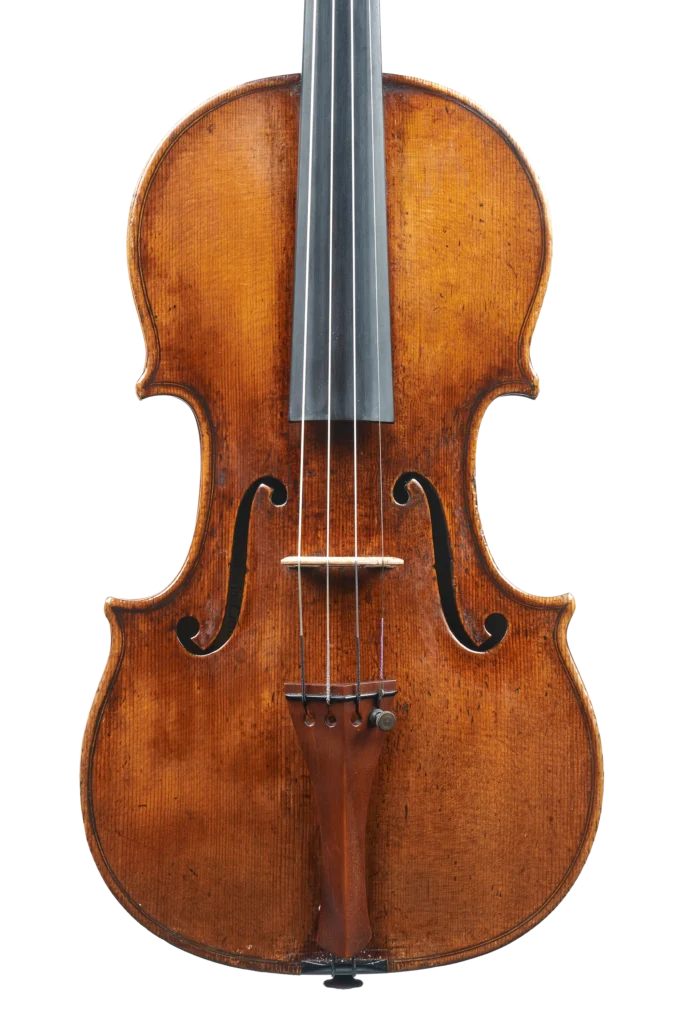
Guarneri del Gesù’s craftsmanship differed profoundly from that of Antonio Stradivari. Where Stradivari pursued refined symmetry and polished precision, del Gesù embraced a freer, more instinctive approach. His violins often reveal fuller arching, boldly cut f holes, slightly asymmetrical corners, visible tool marks, and a varnish of remarkable depth and character.
These features were not imperfections. They were expressions of individuality. The tonal result is unmistakable: darker, more powerful, raw, and explosive in projection.
In Paganini’s hands, Il Cannone became more than wood and varnish. Its voice matched his temperament. It could whisper with intimacy or thunder with force, filling vast concert halls without amplification. He did not tame the instrument’s nature. He amplified it. The partnership between maker and virtuoso transformed Il Cannone into an artistic force that altered the trajectory of violin performance.
Who owns Il Cannone?
After Paganini’s death in 1840 in Nice, the violin remained in his native Genoa. Today it is preserved at Palazzo Tursi, where it is carefully maintained as a cultural treasure. It is brought out only on rare occasions and entrusted to select violinists. More than 180 years later, it continues to demonstrate the same commanding presence that once stunned Europe.
For those of us in Cremona, Il Cannone is more than a historic relic. It is a benchmark. At Amorim Fine Violins Cremona, we view instruments not as objects but as living voices shaped by tradition, intuition, and individuality. The legacy of del Gesù reminds us that true greatness does not come from sterile perfection, but from character, courage, and a deep understanding of sound.
Il Cannone stands as proof that a violin can transcend utility and become art. It connects the golden age of Cremona to the present day, challenging modern makers and musicians alike to pursue instruments with soul, projection, and identity. In that sense, its roar has never faded.
A Legacy That Endures
Paganini’s reputation followed him even after death. Because of the powerful myths surrounding him, he was initially denied a proper burial. Yet controversy never diminished his artistic impact.
He expanded the language of the violin permanently. He redefined the meaning of virtuosity. He demonstrated that an instrument, in the hands of the right artist, can transcend craftsmanship and become legend.
Niccolò Paganini was not only a man of myth. He was a force that reshaped music. And through Il Cannone, preserved in Genoa, his voice continues to resonate into our own time.
At Amorim Fine Violins Cremona, we honor that legacy by embracing the same pursuit of character, power, and individuality that defined the golden age of Cremonese craftsmanship.
For musicians and collectors who seek more than an instrument, but a voice with identity and depth, we invite you to discover our curated selection of fine violins and experience a tradition where artistry and sound become inseparable.
Talk to a specialist about this topic

Featured Instrument
 AVAILABLE
Violin by Antonio Stradivari "Lam; Ex-Scotland University"
Antonio Stradivari — c.1734
View Instrument