


How Matteo Goffriller Shaped Venetian Lutherie Beyond Cremona
Back to BlogWhen discussing the giants of Italian violin making, names like Stradivari and Guarneri often dominate the conversation. Yet behind the brilliance of Cremona stands another master whose influence resonates just as powerfully.
Matteo Goffriller was not only one of the most important Venetian violin makers of the late 17th and early 18th centuries, but also the founder of a school of lutherie that gave Venice its own unmistakable musical voice.
Though his name may be less familiar to the general public, Goffriller’s instruments, particularly his cellos, are among the most coveted in the world today. His work bridged traditions, absorbed international influences, and laid the groundwork for generations of Venetian makers who followed. To understand Venetian violin making, one must begin with Matteo Goffriller.
Who Is Matteo Goffriller
Matteo Goffriller was born in 1659 in Bressanone (Brixen), a city nestled in the Tyrolean Alps. Very little is documented about his early life, but historical evidence suggests that he may have trained under Matthias Albani, one of the most respected luthiers in the region. This early exposure likely gave Goffriller a solid technical foundation rooted in Alpine and Germanic traditions.
In 1685, Goffriller made a decisive move that would define his career: he left his homeland and traveled south to Venice. At the time, Venice was one of Europe’s wealthiest and most culturally vibrant republics, a magnet for artists, craftsmen, and merchants from across the continent.
His arrival in Venice was likely eased by family connections. His sister, Caterina, was already living there, associated with the workshop of the Kaiser family, established violin makers in the city. Through this network, Goffriller entered the Venetian lutherie scene, eventually marrying into the Kaiser family and inheriting the workshop after his master’s death in 1690.
From that moment on, Matteo Goffriller was no longer an apprentice, he was a central figure in Venetian instrument making.
Venice Scenario and Goffriller’s Approach
To understand Goffriller’s success, it is essential to understand Venice itself. Known as La Serenissima, the Venetian Republic was a powerful, independent state whose wealth came from trade. Its strategic control over the Venetian lagoon, parts of northern Italy, and key Mediterranean routes allowed the city to flourish economically and culturally.
By the late 17th century, Venice was experiencing a golden age of art and music. Antonio Vivaldi filled churches and institutions with new compositions, painters like Canaletto immortalized the city’s landscapes, and theater thrived through figures such as Carlo Goldoni.
This environment created a constant demand for high-quality musical instruments. Unlike Cremona, where makers such as Stradivari often produced instruments for distant patrons and aristocracy, Venetian luthiers worked for an active, local musical ecosystem. Goffriller responded directly to the needs of performers, crafting instruments with power, projection, and expressive depth suited to public performance spaces.
Venice’s position as a major trade hub also shaped its violin-making tradition. Materials, ideas, and stylistic influences flowed in from Austria and Germanic regions, blending with Italian craftsmanship. Goffriller stood at the center of this cultural exchange, absorbing and refining these elements into a distinctly Venetian approach.
Matteo Goffriller’s Influences and Main Traits
Matteo Goffriller’s work reflects a dialogue between tradition and innovation. Influenced by the elegant outlines of Niccolò Amati, his instruments maintain refined curves and balanced proportions rooted in the Cremonese school. However, Goffriller introduced bolder features: fuller archings, broader models, and stronger outlines that gave his instruments both visual authority and sonic depth.
These traits are especially evident in his cellos, widely considered his greatest contribution to instrument making. Goffriller’s cellos are known for their rich, powerful tone and expressive range, qualities that later made them ideal for solo performance.
His craftsmanship is recognizable in the details. Goffriller’s scrolls are compact yet elegant, often extending gracefully beyond the pegbox. His f-holes are boldly carved and centrally placed, combining Amati delicacy with Tyrolean robustness. The varnish, ranging from golden amber to deep Venetian red, became a defining characteristic of the Venetian school and contributed to the warm, glowing appearance of his instruments.
Goffriller was also attentive to developments beyond Venice. By the late 17th century, instruments by Antonio Stradivari had begun circulating in the city, and some of Goffriller’s violins from this period show clear inspiration from Stradivarian models. The resemblance was sometimes so striking that certain Goffriller instruments were later misattributed to Stradivari himself.
How Are the Cellos of Matteo Goffriller?
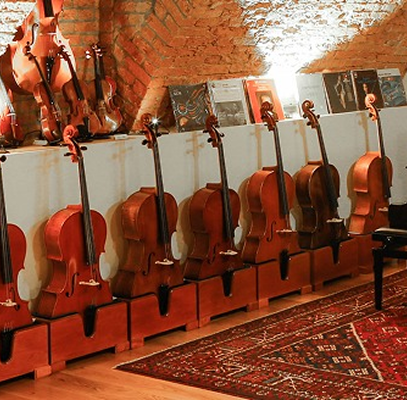
The cellos of Matteo Goffriller occupy a singular place in the history of string instrument making. They are widely regarded as some of the most powerful and expressive cellos ever built, combining structural boldness with remarkable tonal depth.
Some of their main traits are:
- Highly expressive and powerful sound: Goffriller’s cellos are renowned for their deep, resonant tone, especially in the lower register, combined with a strong projection that fills large spaces without losing warmth or tonal complexity.
- Larger and bolder models: Compared to later Cremonese standards, many Goffriller cellos feature broader outlines, deeper ribs, and more generous proportions, contributing to their commanding acoustic presence.
- Ideal for solo performance: Their ability to project clearly while maintaining a rich, colorful sound made them particularly suitable for soloistic playing in churches, theaters, and public venues.
- Robust yet responsive construction: The instruments display fuller archings, confident edgework, and solid structural design influenced by Tyrolean and Germanic traditions, balanced with Italian acoustic refinement.
- Dark, noble tonal character: Players often describe the sound of Goffriller cellos as earthy, warm, and noble, with a wide dynamic range and strong emotional depth.
Today, they remain among the most sought-after historical cellos, chosen by legendary performers such as Pablo Casals and admired for their ability to combine strength, depth, and emotional intensity.
Legacy for the Instrument Making Discipline
After 1710, Goffriller continued producing instruments, though many were left unlabeled, possibly to avoid taxes and restrictions imposed by Venetian guilds. While this decision complicates modern attribution, it does not diminish the quality or significance of his later work. Even altered or reduced in size to suit changing musical tastes, Goffriller’s instruments retained their distinctive tonal character.
Matteo Goffriller’s true legacy lies in the school he founded. His approach became the cornerstone of Venetian violin making, directly influencing legendary makers such as Domenico Montagnana, Santo Serafin, Francesco Gobetti, Carlo Tononi, and his own son, Francesco Goffriller. Through them, Venice emerged as one of the most important centers of string instrument making in Europe.
Centuries later, Goffriller’s reputation was powerfully reaffirmed when Pablo Casals, one of the greatest cellists in history, chose a Goffriller cello as his instrument. Through Casals and countless other musicians, Goffriller’s voice continues to resonate on the world’s most prestigious stages.
Matteo Goffriller did more than build instruments. He shaped a philosophy of sound, founded a school of craftsmanship, and ensured that Venice would forever hold a central place in the history of violin making.
Continue the Legacy with Amorim Fine Violins
Matteo Goffriller’s instruments represent a turning point in the history of Italian violin making, where tradition met bold innovation, and Venice found its own powerful voice through sound. His cellos, in particular, continue to inspire musicians centuries later, standing as benchmarks of depth, projection, and expressive character.
At Amorim Fine Violins, this heritage is not only studied, but lived. Through a carefully curated collection of exceptional violins, violas, and cellos, Amorim Fine Violins connects today’s musicians and collectors with the enduring spirit of masters like Goffriller.
Whether you are seeking an instrument with historical lineage, tonal excellence, or artistic soul, the journey continues at Amorim.
Explore the Amorim Fine Violins collection and experience how centuries of craftsmanship come alive in sound.
LATEST POSTS -
Violin Valuation: How to Know If a Violin Is Worth It and Why It Can Be a Smart Investment
-
How Matteo Goffriller Shaped Venetian Lutherie Beyond Cremona
-
Lorenzo Storioni: Innovation, Resilience, and the Last Classical Voice of Cremonas
-
Hilary Hahn: Career, Violin and the Rise of a World-Class Violinist
-
Giovanni Grancino: Founder of the Milanese School of Violin Making
Violin Valuation: How to Know If a Violin Is Worth It and Why It Can Be a Smart Investment
How Matteo Goffriller Shaped Venetian Lutherie Beyond Cremona
Lorenzo Storioni: Innovation, Resilience, and the Last Classical Voice of Cremonas
Hilary Hahn: Career, Violin and the Rise of a World-Class Violinist