

Giovanni Grancino: Founder of the Milanese School of Violin Making
Back to BlogGiovanni Grancino stands as one of the most important yet often overlooked figures in Italian violin making. Active in Milan during the late 17th century, he laid the foundations of the Milanese school at a time when music, politics, and religion were deeply intertwined.
Shaped by courtly patronage, ecclesiastical influence, and evolving musical demands, Grancino developed a refined yet distinctive style that continues to resonate with musicians and collectors today.
This article explores his life, influences, craftsmanship, and enduring relevance in the world of fine violins.
Who Was Giovanni Grancino?
Giovanni Grancino (born in 1637, Milan) is widely recognized as the founder of the Milanese Classical School of Violin Making and one of its most refined representatives. As the earliest active violin maker in Milan whose work can be historically traced, Grancino occupies a foundational position in Italian lutherie outside the more commonly cited Cremonese tradition.
Although no surviving documents definitively confirm his apprenticeship, the level of craftsmanship displayed in his earliest known instruments makes it highly unlikely that Grancino was self-taught.
One of his earliest attributed instruments, today preserved at the Museo degli Strumenti Musicali at Castello Sforzesco in Milan, bears a label suggesting it was made when he was only 20 years old, already demonstrating exceptional technical maturity.
Grancino likely grew up in a musically connected family. His father, Andrea Grancino, was mentioned by Count Cozio di Salabue as a skilled maker, although no labeled instruments by Andrea are known today.
Giovanni also collaborated closely with his brother Francesco, especially in the early stages of his career, though the exact division of labor between them remains unclear.
Musical Landscape in the 17th Century and Grancino’s Approaches
Unlike Cremona or Brescia, where violin making had already flourished since the 16th century, Milan’s violin-making tradition emerged later, shaped directly by cultural demand rather than by an inherited workshop lineage.
By the late 17th century, Milan had become a vibrant musical and political center, deeply influenced by the Baroque movement.
The rise of Italian opera, driven by composers such as Claudio Monteverdi, reinforced the importance of string instruments, particularly violins, violas, and cellos. Chamber music gained prominence, requiring instruments capable of both expressive nuance and projection.
Political and religious forces played a decisive role. Under Spanish Habsburg rule, Milan enjoyed relative autonomy and benefited from strong ties to the Holy Roman Empire. Despite the devastating plague of the 1630s, which wiped out nearly half of the population, the city recovered rapidly.
Wealth became increasingly concentrated within the nobility and the Church, both of which emerged as major patrons of the arts.
This environment created fertile ground for violin makers like Grancino. Demand came not only from professional musicians but also from courts, cathedrals, and parishes seeking instruments capable of elevating both sacred and secular performances.
Collaboration With the Amati Family
For decades, it was assumed that Giovanni Grancino trained directly in Cremona under the Amati family. However, modern research suggests a more nuanced reality.
Grancino’s early production, especially from the 1660s to the mid-1670s, consisted predominantly of violas, and their construction does not strongly reflect Cremonese influence. Instead, these instruments show a distinct Milanese character, suggesting that his earliest instruction may have come from local or alternative sources.
A compelling hypothesis involves Bartolomeo Pasta, who arrived in Milan in 1673 after having lived and worked at the Amati workshop in Cremona. Pasta established his workshop on Contrada Larga, the same street where the Grancino family lived and worked.
This geographic proximity offers a plausible explanation for how Giovanni gained first-hand exposure to Cremonese methods without formal apprenticeship.
From around 1680 onward, Grancino’s work began to show clearer Amati-inspired features: elegant arching, refined proportions, and increased stylistic polish.
Rather than inherited tradition, this shift likely reflects commercial adaptation and access to fine Cremonese instruments circulating among elite patrons.
What Are the Characteristics of a Giovanni Grancino Violin?
Violins by Giovanni Grancino are admired for their balance between elegance and individuality, combining refined workmanship with a strong personal aesthetic.
Typical characteristics include:
- Graceful, Amati-inspired arching with a distinctly Milanese interpretation
- Finely cut, sharp-edged scrolls with confident execution
- Elegant purfling and delicately fluted edges
- Rich red-brown varnish of exceptional transparency and texture
- A tonal character that is warm, resonant, and naturally responsive
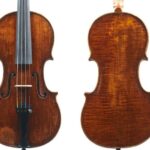
A particularly outstanding example is a 1698 Grancino violin from Milan, which represents the peak of his artistic maturity. Remarkably preserved, this instrument retains a large amount of its original varnish and shows no evidence of heavy French polishing—a rarity for 17th-century violins. Its excellent structural condition suggests minimal intervention over more than three centuries, a testament to both Grancino’s craftsmanship and the quality of his materials.
Insert video: https://youtu.be/Ui2LYlMM534
Nowadays Influence and Relevance
More than 300 years after his death, Giovanni Grancino’s instruments remain highly sought after by collectors, performers, and institutions. His violins are frequently compared to fine Amati instruments, yet they maintain a distinct voice that appeals to musicians seeking individuality alongside historical prestige.
This relevance was highlighted recently by a widely reported case involving a 331-year-old Giovanni Grancino violin, valued at approximately $650,000, which was stolen from a university student in California and later recovered by police. The incident drew international attention, not only because of the instrument’s monetary value, but because it underscored how rare and culturally significant Grancino’s work remains today.
Such events reinforce the fact that Grancino violins are not museum relics alone; they are living instruments, still actively used, studied, and protected as irreplaceable works of art.
Find Your Grancino at Amorim Fine Violins
Giovanni Grancino stands as a cornerstone of Milanese violin making, an artist whose work bridges mystery, refinement, and historical transformation. His instruments reflect a unique convergence of political power, religious patronage, and musical evolution at the height of the Baroque era.
At Amorim Fine Violins, we specialize in historically significant Italian instruments, carefully selected for their authenticity, condition, and musical excellence. If you are searching for a violin that embodies the origins of the Milanese school and the enduring legacy of Giovanni Grancino, our team is ready to guide you in finding an instrument worthy of this remarkable tradition.
Explore the legacy. Experience the sound. Discover Giovanni Grancino and more maker at Amorim Fine Violins.